
Is Democracy Dead?

An Industry on the Cusp: Part One
An interview in multiple parts by Sean Barney

I have worked in restaurants for over half of my life. It is an industry that is very near and dear to my heart. Let me count the ways:
· I met my wife working in a restaurant – she was a regular.
· I saved up for her engagement ring by working in a restaurant.
· The restaurant where I worked gave us a hefty donation of beer for our wedding.
· My son was born while I was employed by a restaurant.
· My son learned to count by doing inventory with me behind the bar at a restaurant.
· All my friends are people that I worked with at a restaurant.
Jason Taggart is my oldest “restaurant” friend. Watching him struggle to try to keep his restaurant afloat during the COVID-19 pandemic has been more than hard to watch. As he is part of my “bubble,” Jason was able to come over to my house for dinner and have a couple pints while we discussed this mess. Appropriately, I made my favorite dish from a dearly departed restaurant.
“I hate journalists,” Taggart jokingly sneers, as we sit down to East Coast Grill inspired chili encrusted tuna tacos. I shoot back, “I don't want to be a journalist, just paparazzi, man.”
Originally, we were supposed to have our chat on Election Tuesday. He had a sniffle on Tuesday and as we are both very cautious, and I see my 80-year-old mother-in-law twice a week, we postponed it a few days until he was at %100. Not shockingly, the election results are still trickling in as we tuck into our tacos. No words need to be minced. “How’s business, buddy?” He takes a big sip of the coffee porter he brought over and says, “It’s shite, mate.”
"It's shite, mate."
Jason opened Democracy Brewing in July 2018 on Temple Place in Downtown Crossing. It was nothing close to as simple as that sentence sounds. He started off as an assistant brewer at John Harvard’s Brewhouse in 2002. Even though he was hired to be the muscle of the operation – to lift bags of grain, carry heavy things up and downstairs, and clean out the tanks – he was pretty sure that this was his calling. He wanted to make his own beer and own his own place. Taggart says it feels like he and his business partner started working on this plan forever ago, “From conception to what could be closing in a month or so, it will be 6 and a half years. Conception and fundraising were about 4 years. Maybe more. We’ve been open for 2 and a half years.”
Jason’s business plan is a unique one and brings its own ocean of uncharted waters. I’m particularly curious about it because I can’t wrap my own head around the concept. So, I ask, “Your business is a worker-co-op, correct? How does that work when everyone owns a piece of it, but no one can work?” Jason helps himself to another taco before he answers this. “So technically, the 13 owners still have their shares so that when things get back to ‘normal’ they will come back in some capacity as worker-owners. They still own a share of the company, if you will.”
I try to get some clarification, “They’re still owners, but they're not getting paid their hourly? It’s not like when you work at a factory when they say, ‘We have to close,’ you're completely done?”
Jason exercises a bit of patience with me, “Right. And a lot of places are doing that. I know a couple of companies that are keeping people on the payroll. However, they aren’t working at the same capacity either. I, also, know a lot of work cooperatives that if you don't work there you just relinquish your shares. Essentially a work-cooperative operates under the stipulation that you have to work there to be an owner. We kind of kept it a little more open just to be fair.”
As Mr. Taggart explains his plans to continue to be a responsible business owner in a time of crazy uncertainty, we look over at CNN. The anticipated “Blue Wave” is not cresting. It feels like it is having trouble knocking a dingy over, at the moment. I try to steer this interview back on course before we get absorbed in the talking heads and result-watching.
SEAN: Ok. So, you’ve got your business. You’re over the dangerous first year. And then COVID hits. Talk to me about that.
TAGGART: So back in March? You just want me to kind of walk you through?
SEAN: Yes. Walk me through it, because I know everyone's experience is the same and, yet, everyone's experience with this is specific and different. What day did you guys have to close the restaurant?
This requires a couple more sips of beer. For both of us.
TAGGART: I want to say it was the 16th when we were done. [Governor Baker’s mandatory shut down for restaurants was the 17th] Yeah. We got the official “close-down” call on Sunday. The day that sticks out most in my mind was the previous Friday. We get a call saying that we have to cut down to, like, 70 percent of capacity. And then the Saturday was like 50 percent and then the Sunday was 20. Sunday, we knew what was coming. Monday night by like five o'clock, it was over. That was it. Everybody's closed down.
SEAN: It felt like everything happened so abruptly. In hindsight, it wasn’t quick enough.
TAGGART: Basically from February 15th through March 15th, we were all just talking about it nonstop because it seemed very foreign. I don't mean that like a [does a Trump impersonation] “CHINA” situation, but it didn’t feel real, you know? Then there's that Biogen party.
SEAN: The fucking Biogen party.
TAGGART: Exactly.
SEAN: That was when it felt like it got very real around here.
TAGGART: It was like one hundred and twenty something people. Again, the numbers are fuzzy, a lot of people got infected and then they spread it because they didn't know. People seemed to be taking it very lightly. Even the NBA at the time. That one guy got it [Rudy Gobert]. He thought it was a joke and kept playing or whatever. But, yeah, that Sunday we were done. I remember that Saturday the pipe band that I’m in went out and did a pub crawl and it was very weird.
SEAN: Right. I was walking with Simon [my son] the other day. We were doing a depressing tour of businesses along Mass Ave. He wanted to see what was still open. We walked by what used to be Grafton Street. They still had signs up for St. Patrick's Day outside. Simon says, “Was St. Patrick’s Day, the day they closed, daddy?”
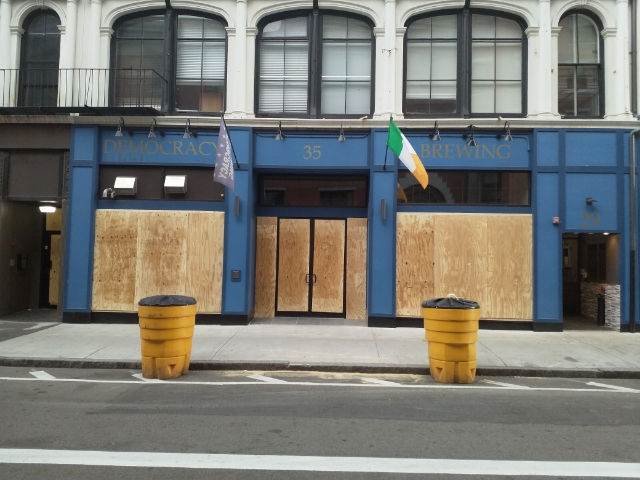
The St. Patrick’s Day that never happened.
Taggart and I have a couple more sips of porter and I go to see if I have any Jameson kicking around the house. This could be a long night. Winter is coming.
Join us next time when we discuss the fallout from the closures and whether or not we see a future for a once vibrant and near-essential industry.


Comments